
Outbound
This is the story of my pilgrimage to Alliance, Ohio for the annual Taylorcraft Fly-in. I had the plane all gassed and ready to go the day before, so I was able to get off the ground at 5:30 on Friday morning, July 7th. There was a thin line of virga running through Jay which caused some concern, but after that I went up to 4500′, and it was clear and calm. It stayed that way; just sit with my hands in my lap and watch the scenery go by. I made a quick pit stop at Keene at 7:30. Nobody was awake there yet. I continued at 4500′ over Great Barrington, Old Rhinebeck Aerodrome and the Hudson River by Kingston.
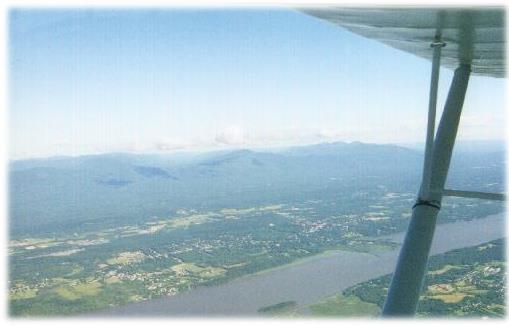
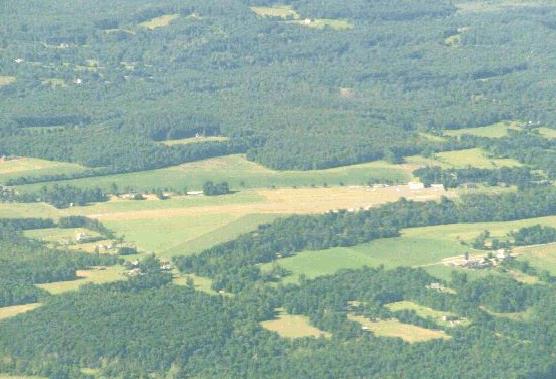
As I rounded the southern end of the Catskills, turbulence started to pick up a bit. Small puffs of cumulus were starting to build right at my altitude. It was here that I noticed a little roughness in my engine and a slight loss of rpm. Carb heat didn’t make any difference. My oil pressure had dropped to 30 lbs. I started researching airports enroute. I was hoping to get to Tunkhannock, PA where there is a friendly airport operator and numerous places nearby to eat. But as the oil pressure dropped below 25, I elected to land right NOW. And below me right NOW was the private airstrip of Cold Spring, PA with a 4000′ paved runway. It was now 10 am.
The landing was uneventful, with the engine idling fine on 10 lbs of oil pressure. I pulled the plane off the runway onto the grass. The engine sounded dry when pulling the propeller through. The dipstick read about a quart, but adding two quarts brought it up to 3 ½. The engine locked up when I pulled the prop backwards, and I knew this flight was over. There were no signs of life. I got out my food, and ate a bagel with peanut butter, some apple sauce, and drank water. It had been a long time since breakfast.
A walk up the slope to the one large hanger revealed that it was unlocked. Looking back outside, I spied a telephone network interface, so there had to be a phone in there somewhere. The door on the corner office inside was also unlocked, and I found a phone set under a bunch of papers on a storage shelf. There was no number on the phone that would at least indicate to me what area code I was in, but there were numbers for Al and Bing labeled on the side of the phone. These must be the good old boys who own this place. A call to Al got me the Allentown automated FSS; Bing was the Binghampton FSS, “Sorry, wrong number.” At this point it was getting a little lonely. I dug out my calling card and called my hanger-mate, Phil Bussiere, at work to let him know that I would need to be extricated. He needed to clean up work at his shop, so he advised me to call back in two hours. I poked around the airport and office and determined that the runway had pilot-controlled lights, and then on the back of the office door, I found a Pennsylvania airport registration, listing airport identifier and phone number, and owner’s name and phone number. I called the owner and got his answering machine, so I told him not to be alarmed if his security system went off, that it was only me down in his hanger office.
I could hear machinery up over the hill, so I walked up to find someone haying. He advised me to walk out to the street and down two houses and catch Lonnie Kominski, the care taker, before he left for his night shift job. Luckily I caught him in time and we drove back in his pickup and towed my plane up the ramp next to the hanger. We only had a short time to talk before he had to leave for work, but at least I got the OK to leave the plane there. I called Phil back with more details, and he said he’d be down that night. I unloaded the plane, had some more to eat, tied the plane down and waited.
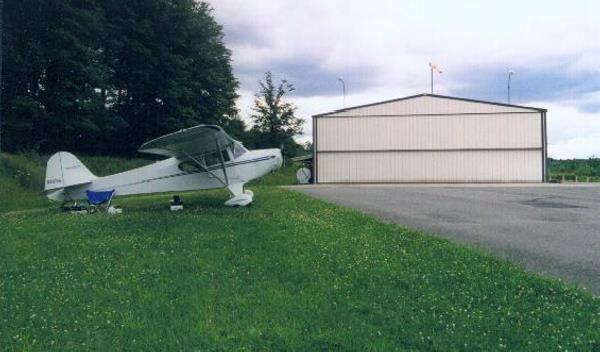
Phil made a low pass and landed at 7:30. The 6 cylinder Continental in his 1947 Bonanza sound just like a small Merlin, but I suppose any engine would have sounded like music then. In a half hour we were loaded and gone. It was a beautiful 2 hour flight back to Norridgewock. As good as the 4 hour flight I had going down.
Recovery
After considering all the alternatives, I got together with Tom Fahy, and over 3 days we got the C85-12F from his Piper J-5 running on a test stand. The engine had been in storage for 13 years.
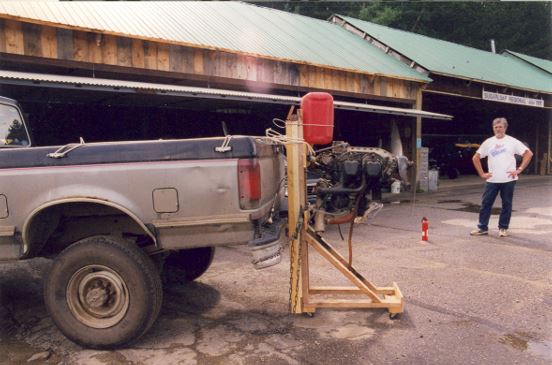
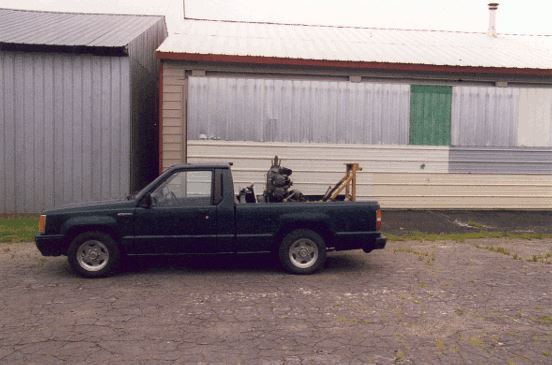
We had to pump STP into the oil screen to prime the oil pump. Although it started and ran pretty well after cleaning varnish off the carb inlet needle, it only developed 20 lbs of oil pressure. I stretched the pressure relief spring out another inch and got the pressure up to 35. The mags checked out OK and there were no oil leaks, so we drained the oil, and into the back of my truck it went, test stand and all.
I took my wife, Cheryl, to Portland on Monday, July 17 to catch her flight to Indiana for a week long conference. At 6 am the next morning I was on the road to PA, for a 9½ hour drive, with the borrowed engine, a portable hoist and tools in the back of my pickup. I went right to work when I got there at 4:30 pm, and had my engine all disconnected before I hit the sack that night. The next morning I pulled my engine and set it down on the grass, then put Tom’s engine in place.
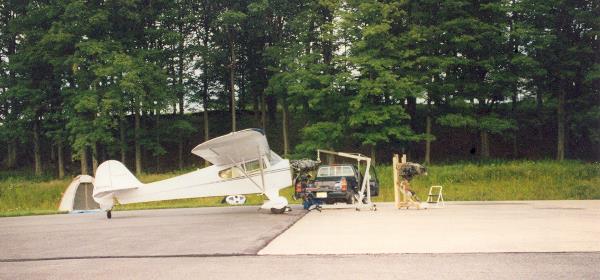
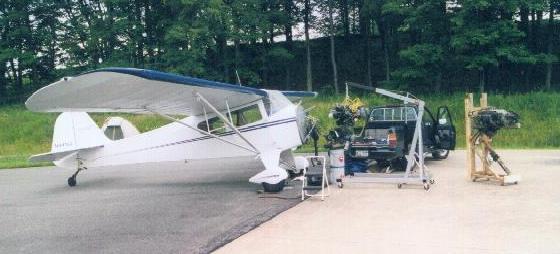
All went well until it came time to connect the oil pressure gauge; I couldn’t get a wrench on the 45 degree, 1/8″ pipe to 1/8″ flare fitting on my case to remove it to put on Tom’s case. I either had to remove the accessory section from my case for access or go into town for a bunch of grease gun hoses to run a temporary gauge under my panel. A long shot was to drive to the nearest airport and hope that the mechanic there had a suitable fitting in his scrap pile. At 2:30 in the afternoon that’s what I decided to do. I drove down out of the hills, through the heavy traffic of Honesdale, where I noted the location of auto parts stores, to the next village beyond, where I asked for directions to the Cherry Ridge Airport at Delightful Bob’s Used Car Sales. Delightful Bob was sitting on the floor of his single garage bay, putting a Ford V-8 engine together. He told me to go back to the blinking light, turn left, then turn right going up the hill. There were four right turns going up the hill and I tried them all, but I pulled into the airport at 4:00 pm sharp, just as the mechanic was turning off the hanger lights and walking out the door. When I described what I wanted, he pawed through the pile of parts on top of his bench and produced exactly what I needed, and said it was mine if it would solve my problem.
On the way back through Honesdale, I stopped at Arby’s for a large roast beef sandwich and a large shake. Thus reconstituted, I was able to finish the engine installation that night and get it started. The oil pressure picked right up. Things looked good for the next morning.
There was a very heavy dew that night. The water dripped off the hanger roof unto the lower shed roof over the airport fuel tanks. It was a form of Chinese water torture and I didn’t sleep well. While eating breakfast on the tailgate of my truck the next morning, a very healthy coyote wandered past, on the trail of the deer that wandered past minutes earlier.
Now the engine would start with difficulty, then sputter and die. After checking everything else, I surmised that condensation on the fuel level float wire had found it’s way into the carburetor, so I drained the float bowl. This of course involved removing the cowling, the heat box and safety wire, but it worked. I took off and circled the airport for .2 hr. The oil temperature stayed below 180, and the oil pressure stayed above 30. I landed, divided my belongings between the truck and plane, parked the truck, and flew the nine miles to Cherry Ridge with no problems, where I got gas and a second breakfast. I took off for home, but upon passing through 3000 feet, I noticed the oil pressure down to 20 lbs. It wasn’t much further to go to Cold Spring where my truck was than to go back to Cherry Ridge, so I set up a gradual descent for Cold Spring. I tied the plane down there and drove home. It was 12:30 pm already. I didn’t want to wait around for the engine to cool off. I had to get home, build a fire in my boiler to make some hot water to take a shower, get a little sleep, and be at a meeting the next morning.
Inbound
I ordered a new oil pressure relief valve spring, then waited for weather and schedule to come together. Finally, Phil Bussiere and I met at the Norridgewock Airport for an early departure in his Bonanza on August 9th. We got off at 6:45 and filed IFR. We were in clouds and rain most of the way at 8000′, but the 3000′ overcast and 3 mile visibility in mist at the destination area that was forecast had improved to 5000′ broken and haze. Strong head winds and vectoring had added an hour to our expected flight time, so we landed first at Cherry Ridge for breakfast at the airport restaurant. It wasn’t open. We also didn’t like the harangue we got over the radio from the instructor in the pattern for making an upwind entry. We flew another 35 miles west to Tunkhannock, where I knew there were several eating options close to the airport. After breakfast at the restaurant next to the airport, we returned east to Cold Spring. As we taxiied in, we scared up a family of wild turkeys next to the runway. By now it was around 11:30 and hot and very humid.
I attempted to pull the oil screen on the engine, but the temperature bulb wouldn’t budge, and rather than chance breaking something, I tightened back up and left it. I found my prize elbow from Cherry Ridge to be plugged. Blowing and poking with safety wire freed that up, and I was able to hook the oil pressure line back up. Next I pulled the oil pressure relief valve and put in the new spring. I buttoned up the cowling, checked the fuel vents for mud daubers, drained the fuel sumps, and tried hand propping. It wouldn’t start no matter what I tried. In desperation I launched into the long procedure to drain gas from the carburetor float bowl; it had worked before. Phil took off for the Poconos to look into vacation reservations. While he was gone, I managed to start the engine, I think by draining gas and leaving the fuel valve shut. I ran it for ten minutes, but now the oil pressure was only 28 lbs. I was just finishing up adding washers under the relief spring when Phil got back.
We couldn’t get the engine restarted. I ended up draining the carburetor float bowl two more times. While all this was going on a bear and two cubs wandered out and sat on the center line of the runway. They disappeared when my engine back fired. I had made pulling the prop through look like so much fun that I got Phil into doing it. Actually I was exhausted and ready to burn the plane and come home. I had a head cold, and it must have been 90 degress and 90% humidity. I would rather have laid in the grass under the wing and slept. Phil realized that even the Bonanza was a little hard to start because of the high density altitude. Cold Spring is at 1400′. We tried with the mixture pulled out halfway. Eventually this worked. We hurriedly packed everything up and did a radio check. The batteries in my handheld had gone dead. We needed a new plan, and fast; it was now 4:30. Phil would pass me and wait at Great Barrington, Keene, and Windsock Village. If everything was OK, I would buzz each strip and fly on.
I climbed out to 3500′. Twenty miles out the engine missed a beat, then came back with 200 more rpm. I took this as a sign that the sticking exhaust valve in the one wheezing cylinder had freed up and not that the engine was disintegrating, and I resumed breathing. The oil temperature pegged at the 250 mark, and the pressure went down to 12 lbs. I throttled back to around 2100 rpm, and let the tail wind carry me along. The temperature came off the peg, and the pressure came back up to 18 lbs. I stopped looking for pastures and concentrated on navigation after the foot hills of the Catskills were behind me. The engine was sounding smoother.
At Great Barrington I landed and shut down. I had grave concerns about continuing in the present hot climate. But I had a silver bullet. I had a pint of STP along that I was saving for engine prelube on the next engine rebuild. I dumped it all in. This had a dramatic effect. The pressure went right up to 35 lbs. on take off. Then as the temperature pegged on climb out, the pressure eased down to 20, then back up to 22 after throttling back. The flying was actually very good, with calm air and haze that wasn’t all that bad. Almost halfway out, Phil went rocketing past my left wing at 3500′, and I adjusted my compass course on his shrinking silhouette. At Keene it was 7:00 pm; I still had an hour of official daylight, and Windsock was only another 70 miles. I dropped down, wagged my wings at Phil down on the ramp and climbed back out. He went past a short time later.
By the time I got to Windsock Village at 7:45, our decision had already been made independently, to go all the way. In a quick conference at the end of the runway with my engine still idling, it was decided that Phil would go on ahead and turn on the runway lights at Norridgewock. I had two flashlights with me to read the gauges, I had plenty of gas left, and it didn’t get totally dark until the vicinity of Oxford. The lightning flashes dead ahead were cause for concern, but I could only wait to see if the storm was before or after Norridgewock. It was pleasant watching the village lights drift past, and the only discomfort was the red lens Maglight stuck in my head band. The Jay paper mill went by in the right place, and soon the airport beacon appeared ahead. The runway lights came up to full intensity just as I entered downwind for 33. My hanger door was open when I taxied in at 8:45. The ground was very wet. The storm must have just passed through.
 Earth Base Zero